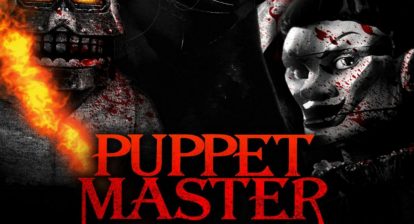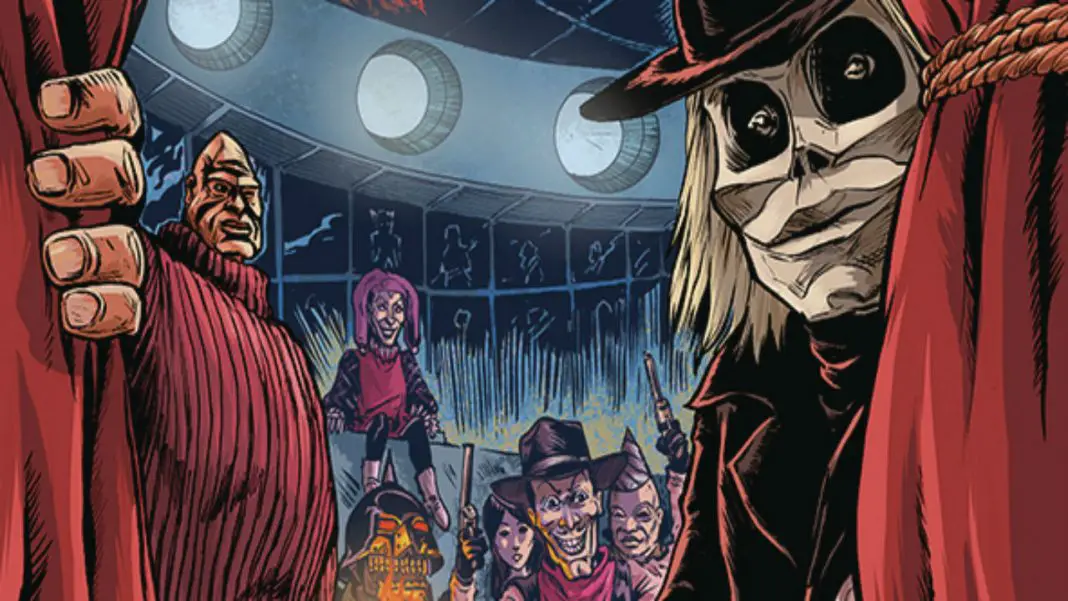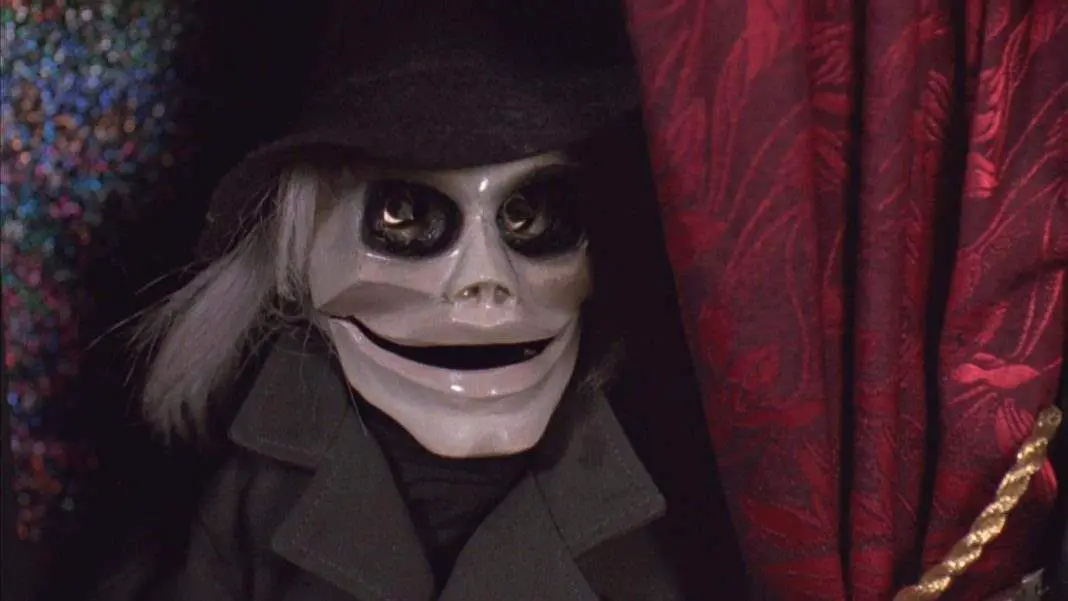
Puppet Master is one of the most successful independent horror film franchises of all time. It’s spawned an action figure series, Halloween costumes, T-shirts, comic books and even a reboot from the producers of Transformers and the writer of Bone Tomahawk. There’s never been a better time to be a fan and I say that with a degree of certainty, because I discovered this film in the late ‘90s when it was already out of print, along with all of its sequels. They couldn’t be bought in stores, so I could only see whichever entries I could find at my local video store.
From the first moment I sat down and watched that original movie, I was hooked. The franchise became an obsession of mine as a kid—and, to be honest, even now to an extent—and the first film has always been my personal favorite. I love the atmosphere of it, the mix of classic Charles Band quirkiness with heightened Dark Shadows-esque melodrama. It’s a low-budget killer puppet flick that plays at Hitchcock and I’ve always appreciated it for that.
Puppet Master didn’t just launch a franchise, it launched an empire. After the bankruptcy of Empire Pictures, Charles Band retooled his gameplan and business model for the booming video market. He decided to create a production company aimed solely at home video releases and thus Full Moon Entertainment was born. It’s a company that persists to this day. But like all iconic businesses, it didn’t get off to an easy start. Puppet Master was the first feature from Full Moon and in many ways it remains the most successful.
Charles Band claims that the initial idea for Puppet Master stemmed from the fact that he wanted another movie about little monsters after the success of Ghoulies and Dolls and the fact that Dungeonmaster was a title that had sold well for Empire. So he wanted something with a similar title and thus Puppet Master was born.


“Everything with Toulon, the puppets, the hotel, the dead man and his surviving girlfriend were the same as mine,” said Hall in an interview with Love-it-Loud. “The main difference was the people going there were not scientists but a coven of contemporary witches investigating the death of their missing friend. They were much more outrageous and flamboyant than how they wound up.”
Ultimately, it wound up taking a different direction. The tone played it straighter, which admittedly make some of the more eccentric Charles Band elements feel out of place at times. But it’s that offbeat, sometimes unexpected quirkiness that is all a part of Puppet Master’s charm. In many ways, it’s the little B-Movie that could. But the road to get it to that point was clearly very challenging, and even in the business of low-budget horror, it felt troubled.
 So many people feel like that got pushed around on this production, and many of them are probably right. But when it comes down to who’s to blame, there are fingers pointing in a few different directions. It’s impossible to say what really went down and to speculate doesn’t do a great deal of good either. I don’t think anyone expected this to become the hit franchise that it became, except for maybe Band himself. And when it did become a franchise, several people felt like they missed out on getting any of the credit for something they helped to create.
To some extent, that begins with Kenneth Hall’s heavily rewritten script. “He wanted to take as much credit as he could and share it with no one,” he said of director David Schmoeller. “I got the Writers Guild on his case for errors and omissions in the credits, not to mention unpaid sequel payments. He was not happy that I did that and the upshot was he always had to write me a check.”
While this doesn’t negate anything Hall claimed in that interview, Schmoeller tells a bit of a different story. But while his experience on Puppet Master sounds very different, it’s not necessarily a more positive one. Speaking of his involvement with the film and relationship with producer Charles Band, Schmoeller has said in an interview with Terror Trap that “Charlie did not want my involvement in the franchise because it would look like I had something to do with the success of the franchise.”
 Adding onto that, Schmoeller talked a bit about his relationship with Band on that film–as well as Tourist Trap and Netherworld, to name just two–with Cut Print Film. “Charlie was a very good producer to work for, because he left you alone for the most part.” But with this particular film he noted, “He owes me money for Puppetmaster, and when I tried to collect it he took my name off the movie and put his name on it.”
Ultimately, the reality is that there are many classic horror films—especially cult classics—that feel like happy accidents. They’re the result of people rushing to deliver something on time and under budget. Puppet Master had very little money to work with and launched a low-budget icon of the video era. The franchise is now prepping to film its thirteenth entry, including the crossover and reboot. In some ways, it’s proving to be as big now if not bigger than it’s ever been.
I have to give credit to Charles Band to coming up with the initial germ of the idea. I have to give credit to Kenneth Hall for molding that into what would become the skeleton of the entire story. I have to give credit for David Schmoeller for taking all of that and molding it into a specific vision.
But I think all of those people would agree that the true success of Puppet Master lies in the late David Allen and his FX team. The designs of the puppets are stunning. The stop-motion sequences, all of the ways in which those puppets were brought to life, captured my imagination as a child and never let go.
 While I’ll fully admit that nothing really happens for the first half of the movie, Puppet Master will always be an all-time favorite of mine. There’s just something endearing about it. I love the Hitchcockian nature of setting up the characters and the situation. It’s similar to Rope in that we as the audience know about the puppets and the danger that the characters are oblivious to. There’s also a classical sense of mystery to it that the other Puppet Master films lack. We saw Andre Toulon, the puppet master, kill himself in the opening scene. It’s the only entry where we don’t reveal until the end who’s really pulling the puppets’ strings.
We’re also gradually introduced to the puppets throughout the feature. We don’t meet them all at once. And there’s something so fun about that, in that we’re left thinking “OK, here’s one with a drill on his head, here’s one that barfs leeches, what’s the next one going to do?”
Ultimately, Puppet Master is all about combining an aesthetic and overall tone from the classic film era and combining that with the inherent campiness of late ‘80s horror. That’s a selling point. That’s ultimately part of what makes the original work, and that’s what helped it to launch a franchise that just keeps going to this day.
It did not have an easy time getting made, not that any movie ever does. There were so many conflicting personalities and ideas from the very beginning that it’s a miracle Puppet Master ever even happened. But it did. It launched a franchise, it launched Full Moon, and it spawned an extremely devoted fan base. As troubled as it may have been, I think that pain was clearly worth it. It remains one of the best features that Full Moon ever produced and will always be a small but fierce icon of its era.