Does the seven-hour Satantango count as a “real” genre movie?
Bela Tarr’s Satantango is one of the most critically acclaimed ‘90s movies that people never actually watch. It’s not that the film is too disturbing or depressing, per se, more the fact that it’s seven hours long. And let’s be real, nobody reading this has the attention span and/or bladder control to sit through any movie THAT long, no matter how great it may be.
Of course, Satantango is undoubtedly a great movie (even if you do have to watch it in thinly sliced two hour chunks over the course of a week or so.) A more interesting question, though, is this: does the widely celebrated arthouse marathon technically count as a “horror” movie?
The answer isn’t readily apparent, but you could definitely argue the case both ways. If you lean towards “it’s not horror,” you have ample evidence. There are no supernatural forces at play, there’s no dramatic music intended to push your emotions one way or the other, there’s hardly any violence or threats of violence throughout the entire movie. It doesn’t feel like a movie whose primary intent is to scare you witless, so that means it can’t be a proper horror picture, right?
Well … that’s debatable.
Sure, there are no ghosts or zombies or people getting chainsawed to death in Satantango. But that doesn’t necessarily mean that it’s NOT a creepy film, or an unnerving film, or a film that makes you feel prolonged bouts of existential dread. You could easily regard it as a philosophical horror movie or perhaps a socioculturally-conscious horror movie — the kind of film where the horror isn’t a physical, external thing, but a general attitude wafting in the air. And with that stark black and white cinematography, it certainly calls to mind any number of gothic horror classics a’la Black Sunday and even the original Night of the Living Dead. The very fact that Tarr chose to film the movie in black and white is something of a tell; Satantango is a film that ALWAYS forces you to contrast the light from the darkness, and needless to say, there is a LOT of darkness coming our way in this film.
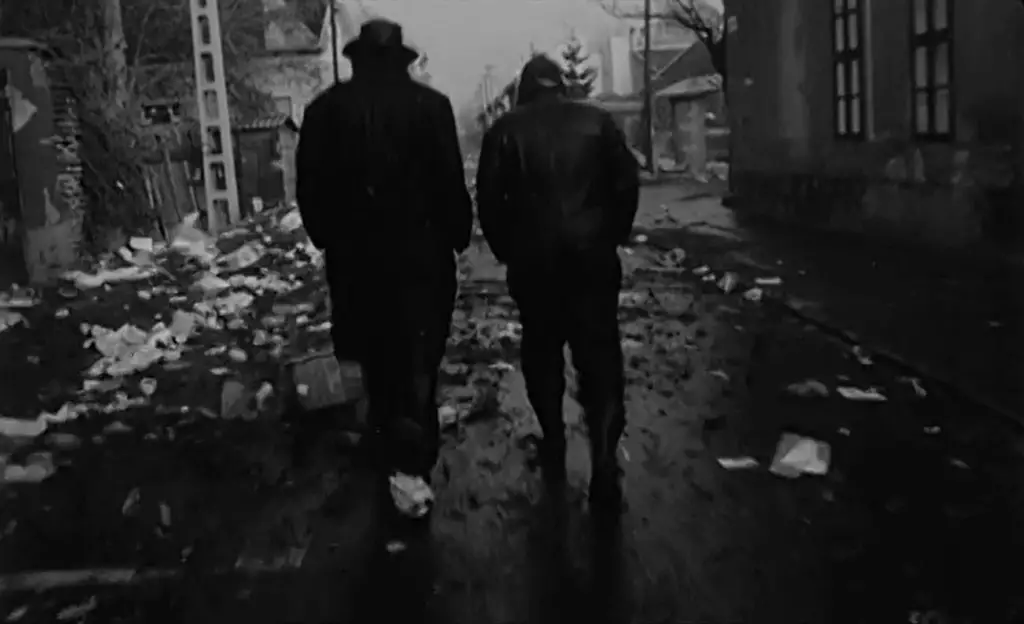

You’ll need to know the backstory of Satantango before you can make any grand declaration about its genre leanings. It’s based on a 1985 book about a remote Hungarian village taken over by a con man who claims to have some kind of messianic power. It’s post-modern stuff that may not officially be horror but you can easily see a horror of some kind within the premise. Indeed, all you’d really have to do to unmistakably make it a horror story is reveal that the false messiah is a werewolf or vampire or something. As it was initially written, though, it’s hard to not interpret the book as a statement about totalitarianism. Hungary, after all, was under communist rule until 1989. But Tarr’s adapatation of the book was filmed well after Hungary transitioned to a “democratic” society. And rather than be a period piece, Tarr’s movie definitely reflects the uncertainty and despair that Hungarians were feeling in the mid-1990s. On a not so subtle level, it’s simply a movie about people shifting from one totally untenable and repressive way of life to a totally different untenable and repressive way of life. It’s a reactionary film about people not being reactionary at all.
The execution of Tarr’s film is pure German expressionism right out of the ‘20s and ‘30s — aesthetically and thematically. It’s a film that tiptoes through a surreal shadow realm between fantasy and reality and even when the film is clearly taking place in the “real world” there’s this odd framing and pacing to everything. It almost feels like the characters in the background are just pretending to be going through the drudgery of daily life in some sort of complex, meta-commentary on filmmaking itself. There’s very much a David Lynch tone to the movie, and more than a few nods to fare like The Cabinet of Doctor Caligari. There are even a few moments of chic nihilism cinema in the vein of Harmony Korine’s output — there’s an emotional disturbance that just permeates every reel of the movie. You may not be able to totally explain it in your native tongue, but you nonetheless feel it in your veins when you watch it.
The story itself is at least horror adjacent. It’s a movie about people slowly descending into madness (with some characters embracing it wholeheartedly) and conniving villains doing whatever they can to rob the poor of what little they have. Murder plots naturally arise, as do suicides. The final scene of the movie sees the one truly cognizant character in the film literally choose eternal darkness over facing the reality of his situation. Toss in a few eyeball injuries and 20 gallons of fake blood or so and you basically have a Lucio Fulci movie on your hands.
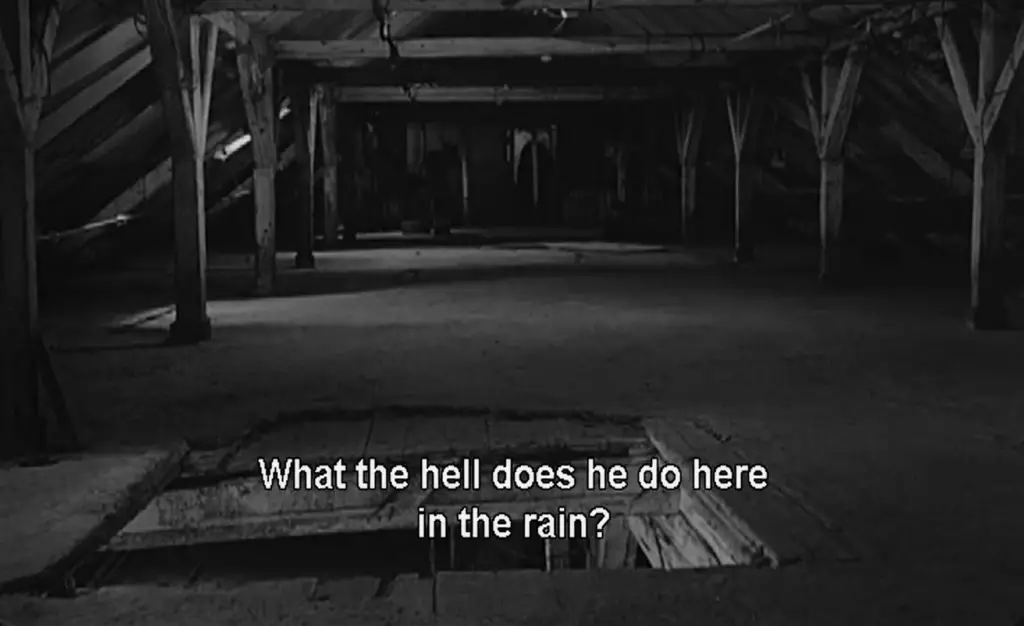
Satantango is a film that still hasn’t been given its props as a narrative. Sure, a lot of people champion it today but they almost always celebrate it in terms of technical merits. You’ll find plenty of people on Letterboxd talking about the movie’s cinematography and its juxtaposition of imagery and especially its long, lingering takes, but you won’t find too many that put the story itself front and center. There’s a lot to chew on, admittedly, but at the end of the day it’s hard to view Satantango as just another post-Perestroika Eastern European melodrama. There’s obviously something deeper and darker going on beneath the surface layer — it’s just that unlike in Tarr’s follow-up film The Werckmesiter Harmonies, he never makes the supernatural implications canonical here.
When you strip the story down to its essence, there’s really not that much difference between something like Satantango and The Purge. Both films are about the same thing — societal collapse — it’s just that they go about it in sharply contrasting ways. You can describe a lot of horror movies as orgies of violence, but in Satantango it’s more like an orgy of ennui and emotional despondency. The intrinsic horror comes from its characters being so indifferent to the horror around them. In a truly bizarre, Rubik’s Cube like twist of logic, Satantango is a movie that makes itself into a horror film by not being a “horror film” at all.
Of course, you might see it otherwise. Maybe Satantango is a horror movie, maybe it isn’t. Or maybe it’s something in the middle that doesn’t have a popular name yet. No matter your perspective, you at least have to buy the argument that there are certain horror-like elements to the film. Which raises the oh-so tantalizing philosophical question: just how much horror does a horror movie have to have to be a “real” horror movie?